How to Reduce Founder Dependency and Step Back from the Day to Day
How to Reduce Founder Dependency and Step Back from the Day to Day
Stepping back from daily operations requires shifting decision-making authority from the business owner to trained, accountable managers. Learning how to reduce founder dependency centres on creating clear escalation boundaries, establishing operational frameworks, and coaching supervisors to solve problems locally rather than seeking routine sign-off.
When every technical query, client pricing concession, or workshop schedule routes through the business owner, growth stalls. What looks like a lack of initiative in the workforce is almost always an absence of management capability and delegation structure.
A 2023 survey of 230 startup founders revealed that 83% of founders feel there are diminishing returns from simply putting in more working hours past a certain point. Working longer shifts will not untangle a company from its creator; developing a leadership tier will.
Key Takeaways
Founder dependency turns business owners into operational bottlenecks, capping output and halting strategic progress.
Promoting skilled technical staff into supervisory roles without leadership training causes issues to bounce straight back to the owner.
Clear boundary frameworks define what managers can resolve independently and what genuinely requires director-level sign-off.
Building self-reliant management teams frees the owner to focus on long-term strategy, client relationships, and enterprise value.
The operational signs of founder dependency
Founder dependency occurs when the commercial progress, technical delivery, or daily functioning of a business rely heavily on one individual. In manufacturing and engineering firms, this rarely appears as total disorganisation. More often, it shows up in businesses that appear structured on paper but grind to a halt the moment the owner steps away.
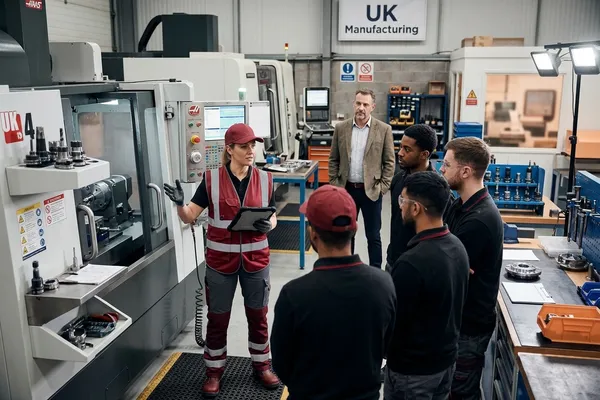
Consider a typical scenario in a precision engineering workshop at 07:30 on a Tuesday. A production supervisor spots a tolerance discrepancy on an aerospace bracket. Rather than consulting the quality manual and agreeing a remediation plan with the client lead, the supervisor halts the CNC machine and waits outside the owner's office. Two hours of machine time are lost waiting for an informal nod from the person who founded the company twenty years earlier.
The business owner becomes the chief problem solver by default. Teams wait for approval, quotes sit in drafts pending final pricing checks, and key customer accounts insist on dealing only with the founder.
When owners examine why their presence is constantly required, they often uncover five recurring symptoms:
Managers escalate upwards whenever an ambiguous challenge arises on the shop floor.
Commercial estimates, supplier disputes, and technical sign-offs remain locked to the owner's inbox.
Staff show competence at executing tasks, but show hesitation when making commercial decisions.
Taking a week away from the business results in stalled orders and an overwhelming backlog upon return.
Turnover plateaus because the operational capacity of the company is tethered to the physical hours of one person.
Addressing these symptoms means addressing how leadership works within the business. To build a business that does not depend on you, authority must be designed into the management structure rather than concentrated in the director's office.
Operational models compared
Different businesses manage authority and daily control in distinct ways. Moving from an owner-led enterprise to a self-sustaining operation involves structured stages of delegation.
Owner-Centric / Informally Delegated / Process-Driven / Leadership-Led - use your GHL table block for this. Decision authority moves from entirely in the founder, to ad-hoc, to written procedures, to distributed across trained managers. Only the last one gives high valuation because value is detached from founder presence.
A practical framework: how to reduce founder dependency
Breaking the cycle of daily firefighting requires a methodical transfer of capability. It is not about walking away from operational standards. Instead, it is about giving trusted personnel the skills, permission, and boundaries needed to exercise judgement.
Stage 1: Document Critical Decisions & Set Boundaries Stage 2: Shift from Answering to Coaching Management Stage 3: Bridge the Technical-to-Manager Capability Gap Stage 4: Formalise What Stays at Director Level
Audit decisions and clarify approval thresholds Begin by categorising the requests that land on your desk across a typical fortnight. Most decisions fall into three tiers: routine operational choices, medium-impact commercial variations, and high-impact strategic commitments.
Establish explicit financial and operational parameters. For instance, permit a production manager to authorise material purchases up to £2,500 or make scrap concessions up to £1,000 without prior sign-off. When boundaries are ambiguous, sensible employees escalate to protect themselves. Clear, documented thresholds remove that hesitation.
Train managers to bring recommendations, not questions When staff members enter your office asking what they should do about a late delivery or a machine breakdown, avoid giving immediate answers. Providing the solution trains your management team to treat you as an intellectual crutch.
Shift the dialogue by requiring a three-step structure before any problem is brought forward:
State the specific issue that occurred.
Outline the practical options that have been evaluated.
Provide a clear recommendation on the best course of action.
Over time, this coaching approach builds decision-making confidence. You will hear fewer questions asking for direction and more briefings explaining what actions have already been taken.
Close the capability gap after technical promotions In manufacturing, firms frequently promote their best toolmaker, lead design engineer, or top fabricator into a supervisory or management position. These individuals understand the technical work thoroughly, yet they often receive no formal preparation for the demands of managing people.
Management requires holding difficult conversations, managing performance, handling conflict, and planning capacity. Without these skills, promoted technicians struggle to hold their former peers accountable. To prevent tension, they avoid confrontation and pass difficult personnel or client problems back to the business owner. Closing this gap through structured leadership development gives managers the competence to resolve conflicts independently.
Define what should still come back to you Reducing dependency does not mean abandoning operational governance. Founders need to maintain oversight over areas that affect statutory compliance, enterprise value, and core brand reputation.
Clarify exactly what stays on your desk. Strategic planning, banking relationships, capital expenditure over agreed limits, and board-level hires should remain with the business owner. Everything else can be systemised, delegated, and managed by your leadership team.
The commercial cost of remaining the operational centre
Running an owner-dependent company carries substantial financial penalties. When all decisions flow through a single desk, project delivery slows down, quote turnaround times drag, and operational overheads climb.
The inability to delegate also puts a ceiling on company expansion. In a 2014 survey of 143 Inc. 500 CEOs, Gallup found that leaders with high delegator talent posted an average three-year growth rate of 1,751%, which was 112 percentage points higher than those with limited or low delegator talent. The difference lies in operational capacity.
Beyond missed revenue, founder dependency severely depresses business value during an acquisition or succession process. Potential buyers evaluate operational risk. If client retention, production knowledge, and key supplier terms rely entirely on the seller staying in the building, buyers either discount the acquisition price heavily or walk away altogether. Developing autonomous managers turns an exhausting job into a transferable, valuable asset.
Frequently asked questions
What is the first step in learning how to reduce founder dependency? The first step is recording every operational question, sign-off request, and decision directed to you over two consecutive weeks. Categorising these interruptions identifies whether the bottleneck stems from missing processes, low spending thresholds, or an absence of management training.
Can a business reduce dependency on the owner without hiring expensive external directors? Yes. Most manufacturing and engineering businesses already employ individuals with deep technical knowledge and loyalty who can step up. The missing element is usually formal leadership development that equips these internal staff members to handle accountability, conflict, and operational planning.
How long does it take to step back from day-to-day operations? A structured transition typically takes between six and twelve months. This timeframe provides sufficient opportunity to define decision-making boundaries, upskill your management team, and test operational stability during planned founder absences.
Will customers leave if the founder stops dealing with them directly? Customers often rely on the founder simply because the business has conditioned them to do so. Introducing senior managers as the primary operational contacts on major accounts, while positioning the founder as a strategic director, preserves client confidence while removing the owner from routine service delivery.
What should an owner do when a manager makes a poor operational decision? Use the error as a structured coaching opportunity rather than revoking authority. Review what information was available, examine where the evaluation failed, and establish what will be done differently next time. Stepping back in to take over the work destroys managerial confidence and resets founder dependency.
Moving beyond operational firefighting
Remaining the central cog in your company limits its potential. If you continue handling daily disputes, checking routine quotes, and overseeing shop-floor schedules, the business will remain constrained by your working hours. The risk of burnout rises, senior staff disengage due to micromanagement, and the eventual sale value of the company suffers.
By intentionally investing in leadership capability, setting clear operational boundaries, and mentoring supervisors into trusted managers, you create an enterprise capable of sustainable growth. The goal is an organisation that delivers consistent results because of its internal management strength, not because of your continuous physical presence.
Discover whether your business is genuinely scaling, or whether too many decisions still depend on you:
The Founder Dependency Check™ | Discover If Your Business Depends Too Much On You


