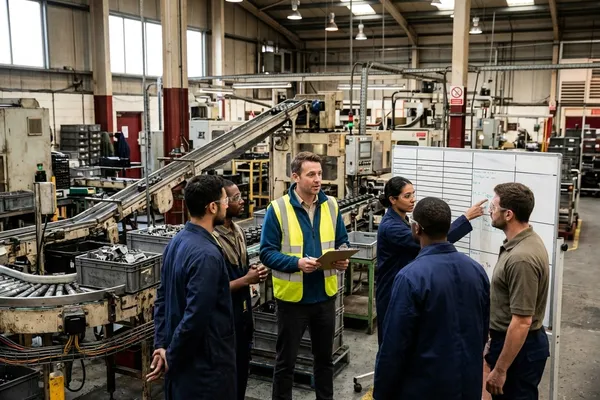
Management Training for Manufacturing Supervisors: Best UK Routes
Management Training for Manufacturing Supervisors: Best UK Routes
The best management training for manufacturing supervisors focuses directly on practical communication, objective performance management, and independent problem-solving rather than abstract corporate theory. For engineering and manufacturing businesses, the most effective programmes equip technical specialists to lead former peers, resolve production bottlenecks, and take ownership without escalating to owners.
Promoting a skilled CNC machinist, fabricator, or assembly technician into a supervisory post is standard practice. Yet running a machine requires a completely different skill set from managing the operators. When businesses treat management as assumed, lines stall, friction rises, and founders get pulled back to solve routine squabbles.
Investing in structured development creates the buffer every growing firm needs. Only 34% of training employers in UK manufacturing provided management training - that gap explains productivity leaks and owner burnout.
Key Takeaways
Promoting without coaching creates bottlenecks and founder dependency.
Practical training must prioritise difficult conversations, delegation, and structured problem resolution over generic theory.
Classroom-only courses fail because they ignore high-pressure plant dynamics.
Supervisors who present recommendations rather than questions free owners for growth.
Comparing Training Delivery Models for Production Supervisors
Training Route | Core Focus | Time to Impact | Operational Disruption | Best Suited For |
|---|---|---|---|---|
Tailored Manufacturing Mentoring | Practical delegation, floor ownership, de-escalation | Immediate (weeks) | Minimal | Mid-sized precision engineering firms |
Formal Accredited Qualifications | Broad theory, employment law | Medium (6-12 months) | Moderate | Established corporate plants |
Apprenticeship Levy Standards | Long-term modules and portfolio | Slow (12-18 months) | High, off-the-job quotas | Large firms using levy pots |
Short Generic Seminars | High-level overviews | Variable (often low) | Low, 1-2 days off-site | Basic introductions for junior leads |
Why Promoted Technicians Struggle Without Support
Yesterday judged on output and scrap rates, today must handle absenteeism, resentment from passed-over peers, safety enforcement, disputes, and dispatch deadlines. Without prep, they do the technical work themselves. Backlog clears but team is unmanaged, and everything escalates to you.
Core Pillars
Holding Direct, Professional Conversations - separate relationships from standards, tackle slip-ups early.
Moving From Open Questions to Recommendation Frameworks:
What happened on the line
What options were considered
What action is recommended
When supervisors stop asking "What do you want me to do?" and start saying "Here is what I recommend", dependency drops.
Objective Delegation - assign with clear owner, quality standard, and deadline. Follow up without hovering.
The Value in UK Manufacturing - UK manufacturing value chain contributed £331bn in 2022. Without leadership, rework climbs, skilled staff leave, deliveries fail. Developing supervisors is central to Building a Business That Doesn't Depend On You.
FAQs
What should training include?
Direct communication, performance management, delegation, root-cause analysis, peer-to-leader transition.
Why do generic courses fail?
Office case studies don't match line pace.
How long for results?
Communication in 3-6 weeks, structural habits in 3-6 months.
How to measure ROI?
Scrap rates, OTIF, turnover, and fewer daily escalations to founder.
Moving Beyond Founder Dependency
Leaving supervisors to sink or swim caps growth. Equip them and you shift from single-person reliance to team ownership.
Discover whether your business is genuinely scaling, or whether too many decisions still depend on you by taking the Founder Dependency Check:
The Founder Dependency Check™ | Discover If Your Business Depends Too Much On You


